

He was a teacher before he was a banker.
Lloyd Hutt didn't open a bank. He opened his front door — and changed West Michigan banking forever.
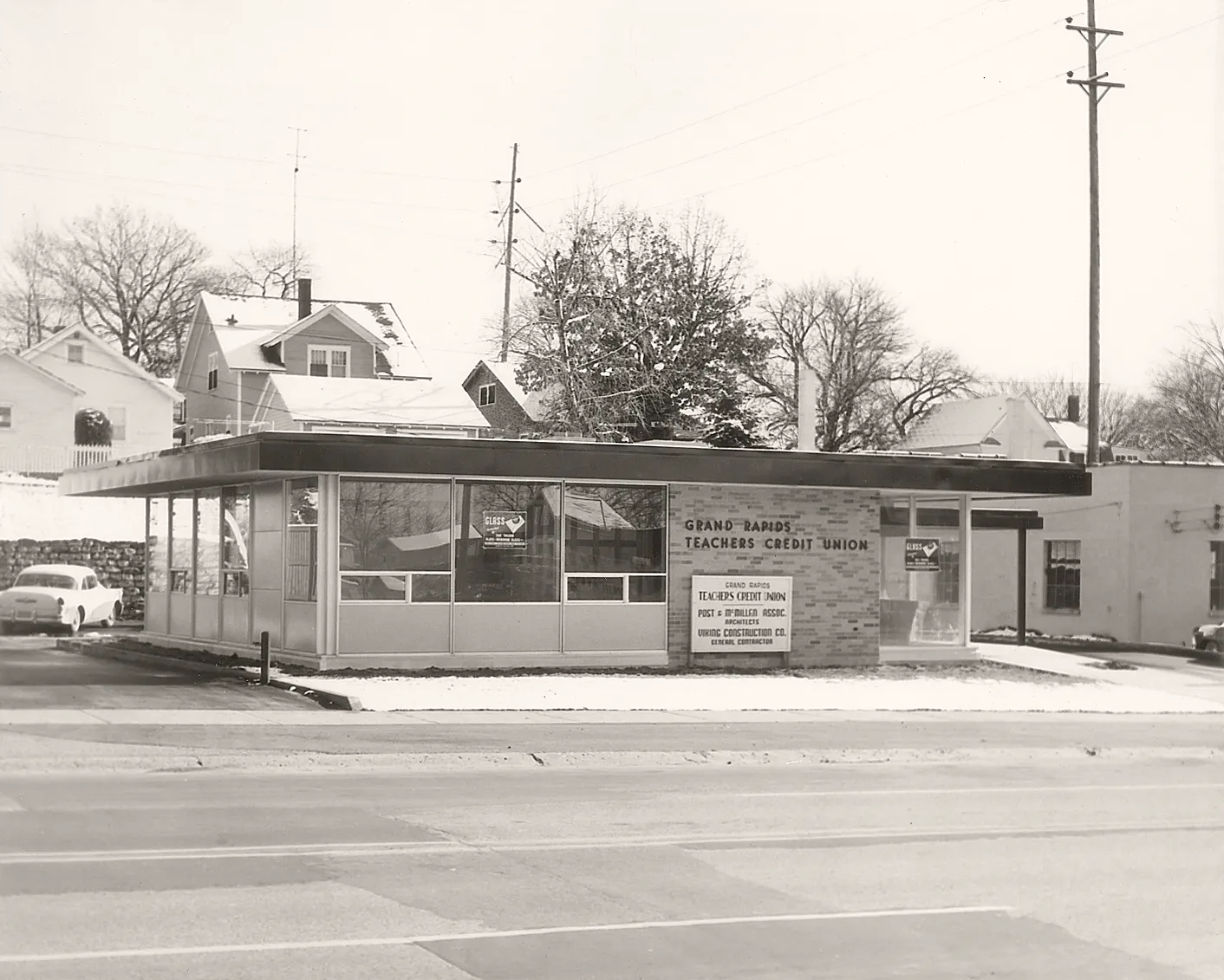

A living room. A big idea.
October 1933. The Depression is grinding. Schoolteacher Lloyd F. Hutt gathers 13 colleagues, pools their savings, and starts a credit union out of his own home. Not because he was a banker. Because teachers find a way. That living room became Grand Rapids Teachers Credit Union. That idea became LMCU.

A credit union timeline: 1933 to today.
Every merger, every new branch, every milestone — all of it in service of one idea: a financial institution that answers to its members.
In October, schoolteacher Lloyd F. Hutt gathers 13 colleagues, pools their savings, and founds Grand Rapids Teachers Credit Union — operating out of his own home. Credit union founded in 1933 to serve educators who needed more than Depression-era banks could offer.
With more than 1,000 members and over $1 million in assets, the credit union outgrows Hutt's living room and moves into its first dedicated office at 2424 South Division Street in Grand Rapids.
Assets surpass $10 million. GRTCU opens its Michigan Street office and begins managing three additional credit unions: Food Marketers, Health Care, and Saint Mary's Hospital.
Total assets reach $120 million with approximately 33,000 members. GRTCU acquires Aquinas College Credit Union. Assets for the managed credit unions pass $40 million.
The Total Lending Center opens, bringing 24/7 lending service to members. GRTCU launches its first internet presence. Food Marketers Credit Union becomes Alliance Credit Union.
GRTCU acquires Blodgett Hospital Credit Union. PC Home Banking launches in 1997; Internet Home Banking follows in 1999. A LAN network is installed at headquarters, connecting the modern credit union to its digital future.
The managed credit unions — collectively known as CU Financial Group — consolidate into one. Grand Rapids Teachers Credit Union stands alone, stronger for it.
A new name. A new chapter. Lake Michigan Credit Union is born from the consolidation of the CU Financial Group. The community charter expands membership to anyone who lives, works, worships, or attends school in Kent, Ottawa, Muskegon, and Allegan Counties.
LMCU acquires Grand Shore Credit Union in Grand Haven, extending its reach to the lakeshore.
LMCU celebrates 75 years. The charter expands again. Membership is now open to those in 36 Michigan counties.
LMCU acquires Kalamazoo-based Citizens Credit Union. Total assets reach $2 billion. The credit union that started in a living room is now a major Michigan financial institution.
Total assets reach $3 billion. The growth isn't the story. It's what that growth means: more members served, more home withing reach, more communities supported.
LMCU expands into southwest Florida, bringing the member-owned credit union model to a second state.
Total assets reach $4 billion. LMCU becomes the largest credit union in Michigan. A milestone earned through 83 years of showing up for members.
LMCU acquires Encore Bank, surpasses 400,000 members, and reaches $5.46 billion in total assets.
LMCU reaches 500,000 members and $9.24 billion in total assets. A half-million people trusting one institution. The one Lloyd Hutt started in his living room.
LMCU begins a 10-year partnership with the West Michigan Whitecaps and secures naming rights to LMCU Ballpark. LMCU acquires Pilot Bank and reaches $11.67 billion in total assets.
LMCU has built a reputation for member service and community involvement. Total assets reach $11.9 billion. The teachers' credit union is now returning more to members than any comparable institution in the country.
LMCU celebrates 90 years and reaches $13 billion in total assets. Another year of member growth brings thoughtful expansion into new communities, with branches opening in Sterling Heights, Michigan and Sarasota, Florida, plus notable growth in Grand Rapids.
LMCU welcomes its 600,000th member and grows assets to $14.5 billion. Three new branches open — Cape Coral Del Prado in Southwest Florida, and North Muskegon and Greenville in Michigan. LMCU also welcomes a new CEO, Julie Leonard, who brings more than 25 years of credit union leadership experience to the role.
LMCU continues to grow across its major Michigan and Florida markets — growth that translates directly into community impact, with more than $4 million given back to local causes this year alone.
LMCU earns the Callahan & Associates #1 Return to Member1 distinction for the fourth consecutive year, surpasses 655,000 members, and keeps growing — in Michigan, in Florida, and in its commitment to the people it serves.
Still just getting started.
93 years in, and honestly? We're more excited about what's next than what's behind us. Explore what LMCU is up to today.
Membership: 669,818
Loans: $13,836,636,274
Assets: $17,351,609,625
Deposits: $14,839,167,681
As of August 31, 2026
Disclosures
#1 for Return of the Member for credit unions above $10 billion in assets. Callahan & Associates, March 2025.
